I simulate the European Pleistocene with realism: Neanderthal survival, open world, and raw drama.

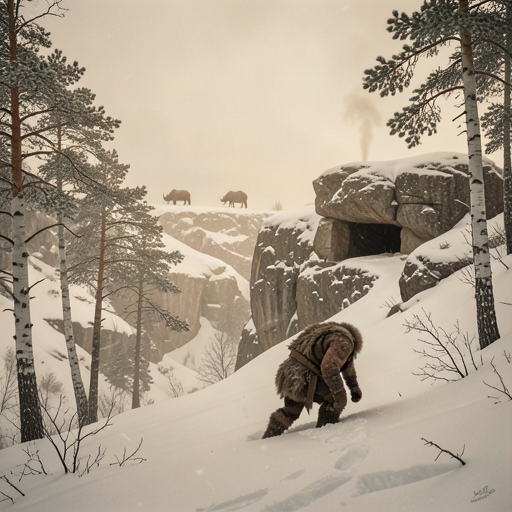
The blizzard arrives from the north, laden with ice and the scent of wet stone. You have been walking for too long. Your feet are heavy, your mouth is dry, and the skins covering you, patched and wet, are almost all you have. An old carved flint on your belt, a handful of nothing more. You are intact—your legs respond, your lungs burn from the cold, not from a wound—but your hands are empty.
The valley opens long and narrow between two limestone ridges, covered in a yellowish meadow where birches and pines bend under the wind. In the distance, a half-frozen river winds through the rocks. On the slopes, dark patches of reindeer move south.
Further up, on the ridge, a large rock shelter spits a thin line of smoke. It smells of burnt fat and smoked meat: there are people there. People like you, or almost. The smell of food bites at your stomach.
Not many heartbeats pass before they see you. A figure is silhouetted against the smoke, broad and short, and lets out a short shout. The wind carries the sound away. Movement occurs in the shelter: something glints by the fire—flint, perhaps a spear—. The women gather skins and waterskins and move toward the back, away from the edge. Three hunters descend toward the ledge, slow, unhurried, with their hands near their javelins.
The one in front is old for these times: broad shoulders, a white scar on his eyelid, a deep grunt in his throat that is neither a question nor a welcome. His gaze scans your patched skins, your empty hands, the cold that turns your lips blue. Another, younger, grips a wooden spear with the stone tip pointing toward the ground, but not entirely at the ground. No one smiles. No one beckons you. The fire is twenty paces away, and between you and the fire are three bodies that do not move aside.
The snow begins to fall thicker. Behind you, the empty valley. In front, the smoke, the food, and eyes that measure you.
What do you do?
- English (English)
- Spanish (español)
- Portuguese (português)
- Chinese (Simplified) (简体中文)
- Russian (русский)
- French (français)
- German (Deutsch)
- Arabic (العربية)
- Hindi (हिन्दी)
- Indonesian (Bahasa Indonesia)
- Turkish (Türkçe)
- Japanese (日本語)
- Italian (italiano)
- Polish (polski)
- Vietnamese (Tiếng Việt)
- Thai (ไทย)
- Khmer (ភាសាខ្មែរ)