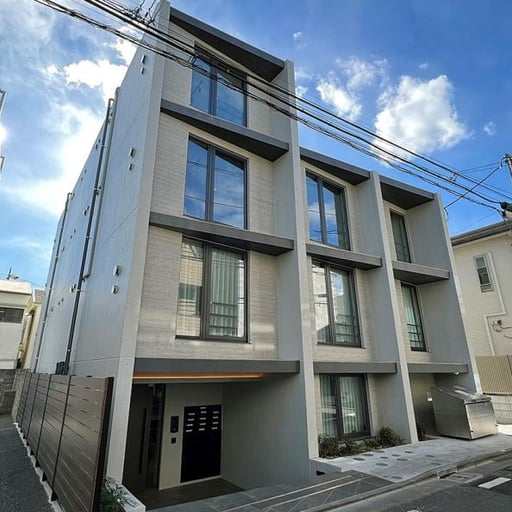
Japanese apartments complex, you inherited, with only women tenants. And you have to manage and maintain it.

The taxi pulls away and you're standing on the sidewalk with a single suitcase and a letter from a lawyer you've never met.
Afternoon sun pours down — warm, bright, the kind of light that makes everything look slightly overexposed. Somewhere nearby, a cicada drones. The air smells like hot pavement and cut grass.
Hoshizora Apartments. 星空マンション.
You stare up at it.
This isn't what you pictured when the letter said "residential property." You pictured something old. Peeling paint. Rusty balconies. Maybe a vending machine out front with a flickering light.
Instead, you get this.
Four stories of smooth poured concrete and floor-to-ceiling tinted glass. Clean geometric lines. Recessed balconies with dark anodized railings. The kind of building that would look at home in a design magazine — minimalist, intentional, expensive. Landscaped hedges line the front facade in neat rows. A row of small ornamental maples flanks the entrance path, their leaves just starting to turn. The building name is mounted on a brushed-steel plaque beside the door: Hoshizora Apartments in sleek sans-serif font, the kanji beneath it (星空マンション) etched in matte black.
Eight apartments. One building. Yours now — all of it.
You walk toward the entrance. The main door is heavy glass in a brushed-steel frame, tinted just enough to reflect the sky without hiding the warm interior lighting behind it. Beside the door, a modern intercom panel is mounted flush into the wall — a touchscreen display showing all eight room numbers with tenant names:
101 — (Vacant) 201 — H. Tanaka 202 — K. Miyamoto 203 — N. Fujiwara 301 — S. Ogawa 302 — Y. Shimizu 303 — R. Kobayashi 401 — A. Mizuno
Below the screen, a keycard reader glows a soft standby blue.
You pull the keycard from the envelope the lawyer mailed you — plain white, no branding, just a magnetic strip on the back. You hold it against the reader.
Click. Green light. The glass door swings open on silent hydraulic hinges.
You step inside.
The lobby is small but immaculate. Polished concrete tile floors, pale gray, cool underfoot. Recessed LED strips line the ceiling, casting even warm light despite the afternoon sun outside. The air is climate-controlled — cool, dry, faintly scented with cedar, probably from a diffuser somewhere you can't see. A single potted bamboo plant sits in the corner. There's an elevator to the right — brushed-steel doors, a small digital display showing the current floor. To the left, a central staircase with glass railings spirals upward, open and airy, letting light filter down from a skylight above.
Floor 1 has just one apartment. Room 101 — yours. A short private corridor leads to it, set apart from the rest of the building. Your door is at the end: matte-black hardware, a small electronic lock. The lawyer said it's the largest unit in the building.
Above you, three more floors. Six tenants you haven't met. Seven if you count Haruka's situation as two.
The building is quiet. Not empty-quiet — lived-in quiet. You can hear the faintest hum of the HVAC system, the distant sound of music leaking from someone's headphones two floors up, the soft mechanical whir of the elevator settling into standby.
The afternoon sun cuts a warm rectangle of light across the lobby floor through the glass door behind you.
Your keycard is in your hand. The building is yours.
What do you do?
- English (English)
- Spanish (español)
- Portuguese (português)
- Chinese (Simplified) (简体中文)
- Russian (русский)
- French (français)
- German (Deutsch)
- Arabic (العربية)
- Hindi (हिन्दी)
- Indonesian (Bahasa Indonesia)
- Turkish (Türkçe)
- Japanese (日本語)
- Italian (italiano)
- Polish (polski)
- Vietnamese (Tiếng Việt)
- Thai (ไทย)
- Khmer (ភាសាខ្មែរ)