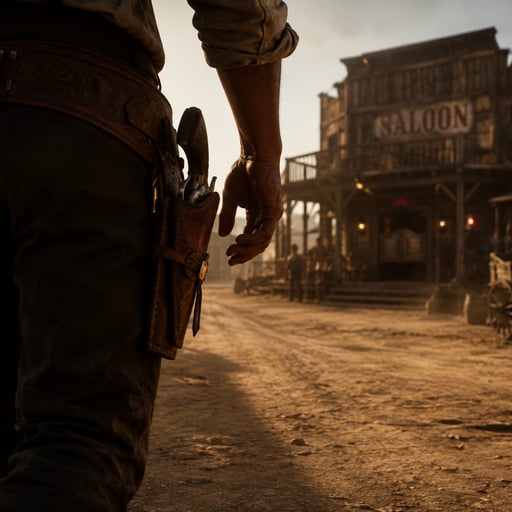

Somewhere between 1865 and 1900, in the American West. You have been riding for hours. The sun is beating down, dust is sticking to your skin, and your horse is starting to tire. From the ridge of an arid landscape, you finally spot it: a small town below. A handful of dusty wooden buildings clinging to a single main street that fades into the dirt. A saloon with a sign creaking in the wind—the liveliest place in this group. Opposite, the sheriff's office, door closed, a rudimentary gallows planted in front like a warning. Further on, an open stable where an old man is shoeing a horse. The general store, a rickety shack with crates of supplies stacked on the wooden sidewalk. A tiny church, a tilted tin bell tower, a rusty iron cross at the top. The blacksmith whose forge is spewing black smoke. A cemetery away from the village, a few wooden crosses leaning in the dust. A few silhouettes move in the orange light of the end of the day. A dog sleeps in the shade of a barrel. Nowhere else can you hear anything but the wind and the distant sound of the anvil. Not much. Just a dot on the map. A place where you come to die or start over. Your horse paws the ground. The canteen is almost empty. The jerky too. In front of you, the desert continues as far as the eye can see. Behind you, the same. You observe the town. No one has seen you. No one is waiting for you. What do you do?
- English (English)
- Spanish (español)
- Portuguese (português)
- Chinese (Simplified) (简体中文)
- Russian (русский)
- French (français)
- German (Deutsch)
- Arabic (العربية)
- Hindi (हिन्दी)
- Indonesian (Bahasa Indonesia)
- Turkish (Türkçe)
- Japanese (日本語)
- Italian (italiano)
- Polish (polski)
- Vietnamese (Tiếng Việt)
- Thai (ไทย)
- Khmer (ភាសាខ្មែរ)