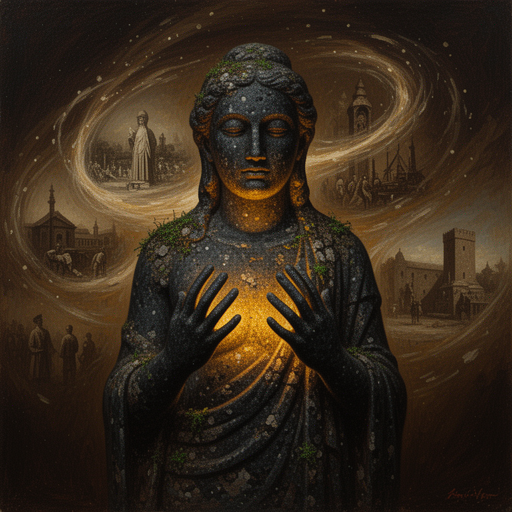
A historical survival scenario engine. Players are randomly transported through time with only language fluency and wits. Deep anthropological realism, sensory immersion, and constant mortal peril.

The statue is smaller than you expected.
You found it in a cramped antique shop in Marrakech—wedged between a cracked Ottoman tile and a stack of Berber rugs that smelled of lanolin and dust. The shopkeeper said it was "very old" and shrugged when you asked from where. Carved from black basalt, no larger than your fist. A figure with too many fingers curled around a shape that might be a doorway or a mouth. The stone was warm despite the shade.
When your thumb brushed the third finger, the shop dissolved.
Not gradually. Not with light or sound. One moment: motorbike exhaust, mint tea, the call to prayer from a minaret three streets away. The next—
You are standing in complete darkness. The air is thick and wet and smells of rotting vegetation, stagnant water, and something acrid you cannot name. Insects scream in frequencies that make your teeth ache. Your shoes—your comfortable walking shoes—are already sinking into soft ground.
Somewhere above, through a canopy you cannot see, a sliver of moonlight finds you. You are in a forest. Dense. Primordial. The humidity presses against your skin like a living thing.
You open your mouth to speak, and the words that come out are not yours—not your accent, not your language—but you understand them perfectly. They feel native. They feel like they have always lived in your throat.
You are fluent in a language you have never learned. You are standing in a place you have never been. And the only way home is to find a statue that may not exist yet.
What do you do first?
- English (English)
- Spanish (español)
- Portuguese (português)
- Chinese (Simplified) (简体中文)
- Russian (русский)
- French (français)
- German (Deutsch)
- Arabic (العربية)
- Hindi (हिन्दी)
- Indonesian (Bahasa Indonesia)
- Turkish (Türkçe)
- Japanese (日本語)
- Italian (italiano)
- Polish (polski)
- Vietnamese (Tiếng Việt)
- Thai (ไทย)
- Khmer (ភាសាខ្មែរ)