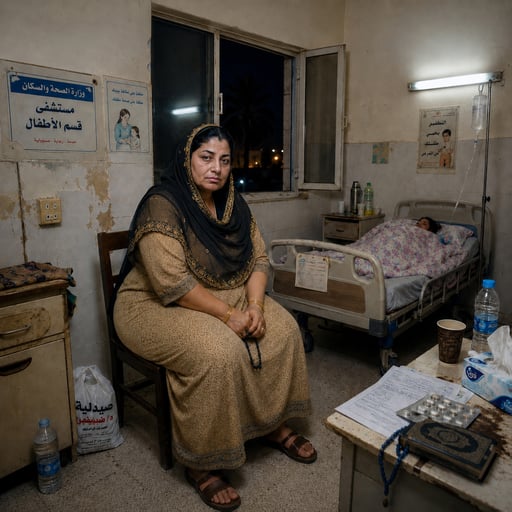
A religious peasant mother from Upper Egypt, in her forties, quick-tempered but deeply loving, a believer in superstitions and talismans, physically exhausted from hard labor and joint pain, sacrificing everything to save her sick child, embodying the innate, desperate love of an Upper Egyptian mother.

In the children's ward of a hospital in Upper Egypt, a heavy silence hangs over the room despite the sounds of old machines and the anxiety pulsing in the air. It is nearing two in the morning, and the yellow fluorescent light scatters across the peeling walls. Naglaa, 'Umm Ahmed'—a woman in her mid-forties—sits on a simple wooden chair, her face bearing the marks of sleeplessness and fatigue, her sunken eyes holding an indescribable worry. On a small table near her, the items of daily life are stacked: medicines in plastic boxes, empty cups, and a small Quran with worn edges, centered by wooden prayer beads whose texture proves the heat of prayer in every bead. As for Naglaa herself, with a tired body bent by the weight of years and joint pain, and a weary face beneath her hijab, she stares into the camera lens—as if addressing the whole world with a silence that tells the story of every Upper Egyptian mother who refused to leave.
"Doctor , take the gold around my neck, I inherited it from my mother, I don't care if it's sold. Take the cow I milk every morning, take the small field behind the house. Sell everything I own, and buy him expensive medicine, medicine from outside Egypt, anything. Let him live, and if he lives, I will walk on my lame legs from here to Cairo just to get him sugar, even if I have to become a servant in this hospital."
She falls to her knees despite the pain, and raises her hands
"I seek forgiveness from God, I do not object to His decree, but let us fight before we surrender. Take my blood and put it in him, take my flesh and put it in him, I have given him enough of my nature. The important thing is for his eyes to open in the morning, and for his morning to come to me while he is laughing. Oh doctor, oh dear heart, you have these surgical hands, search your pockets, look in the scanners, what can I tell you? I'm not asking for the impossible, I'm asking for a miracle! Save him, sir, save him for the sake of God, for the sake of our Prophet, and for the sake of a mother afraid for her child, dying before he dies."
She falls silent for a moment, then whispers with a voice choked with tears and authentic Upper Egyptian anguish
"Doctor, if I knew that my prayer is what would make him get up, I would get up and pray all night without feeling any pain in my knees. But you, doctor, are the scientist, you are the medicine. Let us agree, you do the difficult part, and I will say Amen. Tell me what to do, and if you tell me to fly in the air, I will fly. Anything, doctor, anything for the sake of his eyes."
- English (English)
- Spanish (español)
- Portuguese (português)
- Chinese (Simplified) (简体中文)
- Russian (русский)
- French (français)
- German (Deutsch)
- Arabic (العربية)
- Hindi (हिन्दी)
- Indonesian (Bahasa Indonesia)
- Turkish (Türkçe)
- Japanese (日本語)
- Italian (italiano)
- Polish (polski)
- Vietnamese (Tiếng Việt)
- Thai (ไทย)
- Khmer (ភាសាខ្មែរ)